Skip to main content
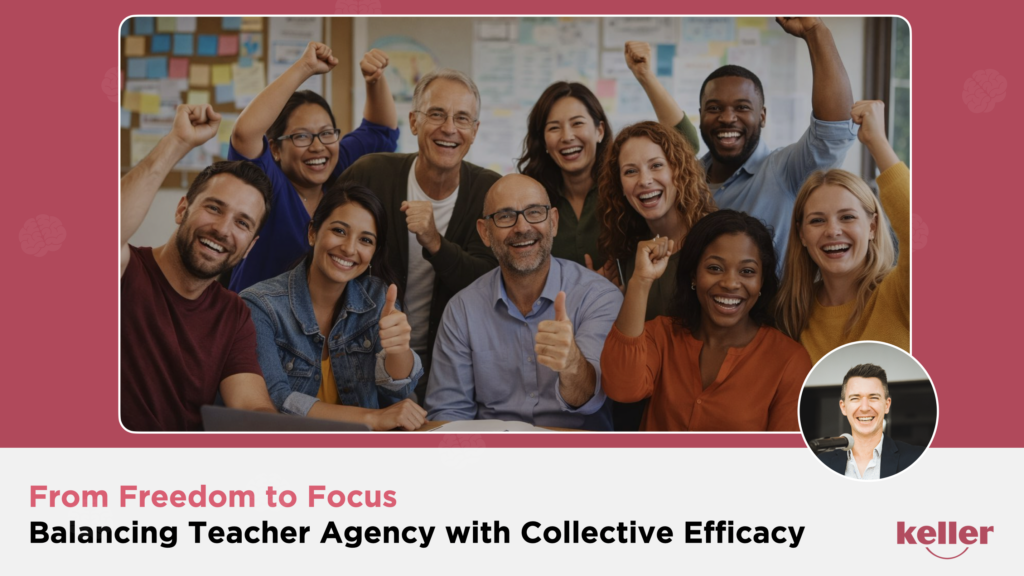
There is a tension at the heart of every good school. On the one hand, we want teachers who think. Who adapt. Who respond to the living, breathing human beings in front of them.
On the other hand, we want consistency. Coherence. A shared language of practice so that learning does not depend on which classroom a child happens to walk into.
So which matters more: autonomy or alignment?
According to Andreas Schleicher and the OECD’s TALIS data, teachers who report higher levels of autonomy tend to feel more confident, less stressed and more satisfied in their work. Experienced teachers in particular flourish when given space to shape lessons and methods. That should not surprise us. Agency fuels professional pride.
But here is the nuance. TALIS shows correlation, not causation. And the data also warns us: Autonomy without coherence can undermine outcomes. In some high-autonomy systems, significant numbers of teachers are never appraised. Leaders simply do not know what is happening in classrooms.
Freedom without shared standards is not professionalism. It is fragmentation. At Keller Education, working with over 250 schools across Africa, we have seen this play out in real time. The schools that thrive are not those with the tightest control, nor those with complete instructional freedom. They are the ones that create what we call Structured Agency.
What is Structured Agency?
Structured Agency is not about telling teachers what page to be on. It is about aligning around how we think about learning.
When a school agrees on:
- What engagement looks like through the lens of RAS and attention
- How feedback should build self-efficacy
- Why psychological safety must precede cognitive stretch
- How inquiry and curiosity drive deeper thinking
Then teachers can innovate within a shared neuroscience-informed framework.
The result? Autonomy with direction.
Schleicher’s analysis highlights something critical… experienced teachers benefit more from autonomy than novices. This is consistent with what we see in schools. A teacher with ten years of classroom wisdom can flex, adjust and refine. A teacher in year one often needs clarity, mentorship and guardrails.
The mistake many systems make is assuming autonomy is a universal lever. It is not. It is developmental. Autonomy is earned through competence, not handed out as a default.
Autonomy only scales when it becomes collective. Research on collective teacher efficacy consistently shows it as one of the most powerful influences on student achievement. But collective efficacy does not emerge from isolation. It emerges from shared language, shared goals and shared reflection.
We often ask schools a simple question:
“Could a student walk from one classroom to another and still recognise your learning culture?”
If the answer is no, you do not have coherence.
If the answer is yes but it feels rigid and lifeless, you do not have agency.
The sweet spot is when teachers feel free to design powerful experiences, yet students still encounter a common ethos: psychological safety, high expectations and structured thinking.
Accountability: The Anchor, Not the Hammer
Schleicher is right to caution against both extremes. Too little oversight leads to invisible classrooms. Too much punitive accountability breeds compliance.
We see the healthiest systems anchor accountability in professional growth:
- Classroom observations framed as learning conversations
- Shared strategic goals owned by staff, not imposed
- Professional learning communities that refine practice together
- Data used as insight, not intimidation
Accountability should feel like an anchor. It keeps the ship steady while still allowing movement.
If you are a school leader reading this, here are five strategic reflections:
- Define your non-negotiables clearly. Not scripts, but principles grounded in evidence.
- Invest heavily in early-career support. Autonomy without mentorship creates anxiety, not excellence.
- Create structured collaboration time. Not ad hoc chats, but deliberate spaces for alignment.
- Observe regularly and respectfully. Visibility builds trust and coherence.
- Celebrate innovation within boundaries. Creativity thrives inside a shared framework.
At Keller Education, we call this building a culture where teachers have “shiny eyes” again.
Where they feel trusted, supported and intellectually challenged. Where innovation is encouraged but never disconnected from science.
The debate is not autonomy versus coherence. The real question is: Can we design systems where teachers feel both trusted and connected? Where professional judgment sits inside shared evidence? Where classrooms are distinct in personality but united in purpose?
The most powerful schools I have walked into feel like jazz ensembles. Each musician is skilled. Each improvises. But everyone knows the key, the tempo and the shared direction of the piece.
That is the future of schooling.