Skip to main content

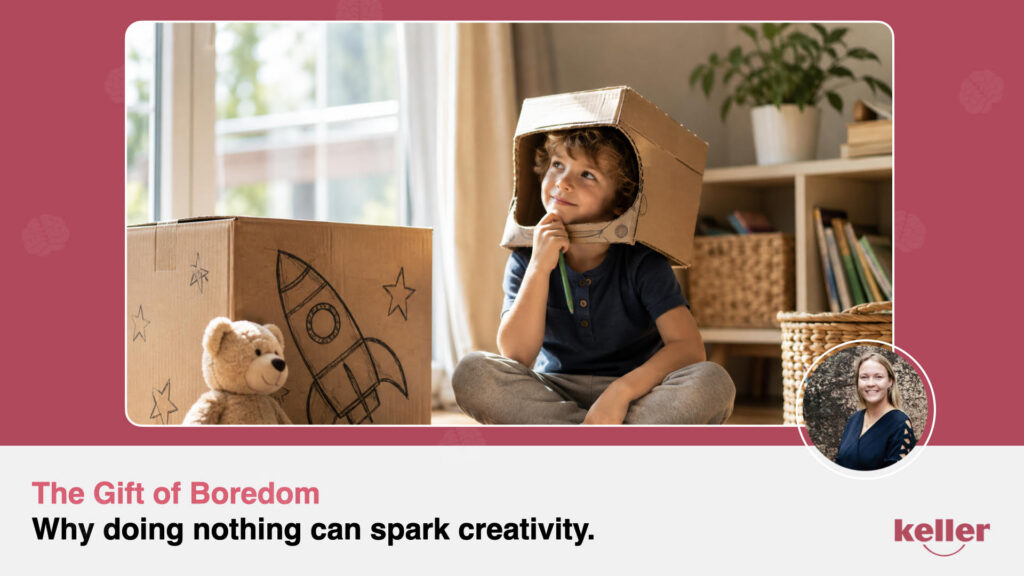
Why doing nothing can spark creativity.
“I’m boooored!”
For many parents, those two little words trigger an almost automatic response.
We spring into action. We suggest a game. Find a snack. Organise an activity. Hand over a device. Suddenly, we are presenting our children with an entire menu of entertainment options before they have even had the chance to figure out what to do next.
After all, boredom feels like a problem that needs solving. But what if it isn’t? What if boredom is actually one of the greatest gifts we can give a developing child?
In a world where entertainment is available at the swipe of a finger and children’s schedules are often filled from morning until evening, unstructured time is becoming increasingly rare. Yet those empty moments may provide exactly the space their developing minds need to imagine, explore, problem-solve and create.
Remember When Boredom Was Normal?
Think back to childhood twenty or thirty years ago. If you announced that you were bored, there was a good chance the response would have been, “Go outside,” or the wonderfully unhelpful, “Find something to do.” And somehow, eventually, we did.
Perhaps there were fifteen minutes of sulking first. But eventually, something happened.
A blanket became a fort. A cardboard box became a car. Leaves and flowers became a particularly questionable perfume. A patch of mud became a dam construction project. A stick became a sword, a wand or whatever else the imagination required.
Nobody necessarily planned the activity for us. We created it and that difference matters.
When We Solve Boredom Too Quickly
Today, children have access to more entertainment than perhaps any generation before them.
When every quiet moment can immediately be filled by a video, game, programme or organised activity, children have fewer opportunities to sit with the discomfort of having nothing obvious to do.
As adults, we often step in with the best intentions. We don’t want our children to be unhappy. We may be tired, busy or simply trying to get something done ourselves. Sometimes handing over a screen is the easiest option, and there is no need for guilt around that.
The question is not whether children should ever use screens or enjoy structured entertainment.
The better question is: Do they also have opportunities to be bored?
Because when we immediately solve boredom for children, we may unintentionally remove the very moment in which they would have needed to generate an idea for themselves.
Boredom Makes the Brain Work
Boredom creates a gap.
There is nothing immediately demanding a child’s attention and nothing telling them exactly what to do next. That gap can feel uncomfortable at first, but it also creates possibility.
A child now has to ask: What could I do? What could I make? What could this become?
This requires initiative, decision-making, flexible thinking and imagination. Instead of consuming somebody else’s idea, the child has an opportunity to generate their own.
Creativity is not simply about being artistic. It is the ability to see possibilities, combine ideas, experiment, adapt and approach problems differently.
These are skills children need far beyond childhood.
Creativity Needs Empty Space
Consider almost any invention, discovery, story, recipe or creative breakthrough.
Somebody, somewhere, had to wonder: What if? Could this work differently? What happens if I try this?
Creative thinking needs room for curiosity, and curiosity does not always emerge when every minute has already been planned.
Children need opportunities to tinker, daydream, build, dismantle, experiment and occasionally create something that makes absolutely no sense to the adults watching them.
When children invent a game, create characters or turn ordinary objects into something extraordinary, they are practising the ability to generate possibilities.
Sometimes our most powerful role is simply to provide the space.
Resist the Rescue
So what should we do when we hear those inevitable words?
“I’m bored!”
Perhaps the answer is… not very much.
Instead of immediately offering ten activities, we can return some responsibility to the child.
“What do you think you could do?”
“Have a look around and see what
you can come up with.”
“I wonder what you could make?”
There may be resistance or frustration. That is okay.
Learning how to move through a little frustration and find a solution is part of developing independence.
We can provide a safe environment and access to simple materials – paper, boxes, books, blocks, outdoor spaces or art supplies – without determining exactly what children should do with them.
Then comes the difficult part for us adults.
We step back.
A Gift Disguised as Nothing
Boredom is not something we need to fear. It is an invitation for children to look around, look within themselves and decide what happens next.
Not every moment needs to be productive. Not every activity needs an educational objective. And not every quiet moment needs to be filled.
Sometimes the fort built from couch cushions, the strange garden potion or the completely invented game with rules that change every three minutes is doing more than we realise.
It is giving a child ownership of an idea.
So the next time you hear, “I’m bored,” resist the urge to immediately rescue, organise or entertain.
Give them a little time. Give them a little space. And give their imagination the opportunity to answer.
Because boredom is not the absence of opportunity.
Sometimes, boredom is where possibility begins.
By Natasha Smith